
Does Haven Extinguish or Suppress Fires? An Honest Answer
0 Comments
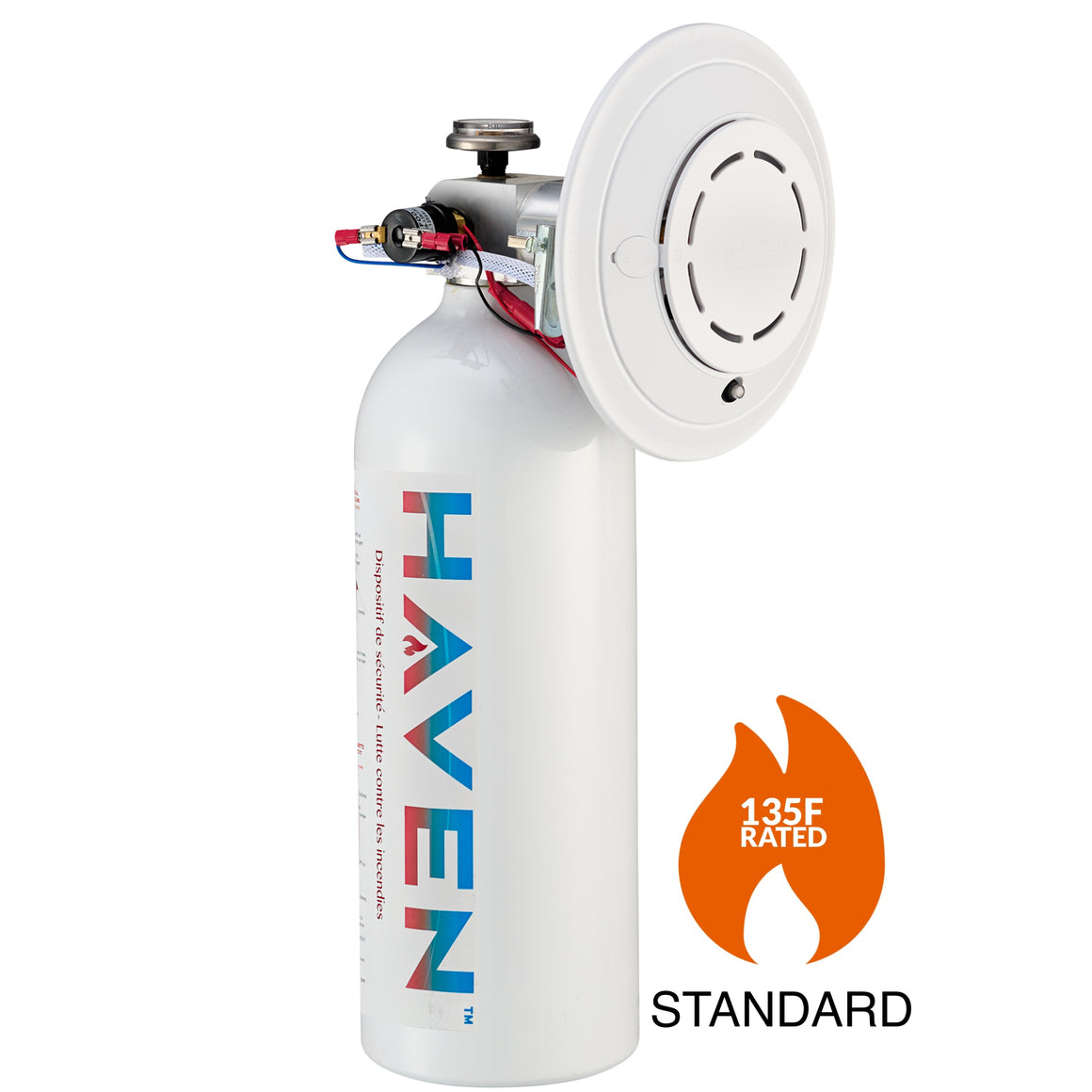
Here is the direct answer, with no marketing gloss:
Haven is designed to suppress fires — to knock down and control a fire in its early stage. In many small-fire scenarios, that suppression fully extinguishes the fire. But Haven does not promise to extinguish an established fire, and no honest maker of a 5 lb device would.
If you've researched Haven, you may have seen that distinction raised as a criticism. We think it's actually the most important thing to understand about residential fire protection — including professional sprinkler systems. So let's take the question seriously.
The question people fairly ask
A few years ago, a homeowner on the GreenBuildingAdvisor Q&A forum asked about using Haven units in a small new build where sprinklers weren't practical. Another participant emailed us directly and posted our reply: "For liability reasons we never actually claim the Haven will extinguish a fire, we claim the Haven will suppress the fire to give you additional time."
Quoted cold, that can sound like lawyer-speak — like a company hedging on whether its product works. It's a fair reading, and it's on us that the answer arrived without context. But the distinction between suppression and extinguishment isn't a Haven loophole. It's how the entire fire protection industry talks — and it's how the industry talks because it's how fire actually behaves.
Suppression vs. extinguishment: what the industry means
In fire protection, these are distinct technical terms:
- Fire control means limiting the size and growth of a fire — holding ceiling temperatures down and shielding nearby combustibles so the fire can't spread.
- Fire suppression means sharply reducing a fire's heat release rate — knocking the fire down and preventing regrowth.
- Extinguishment means the fire has completely ceased burning, with no possibility of reignition.
One-line version: suppression stops a fire from growing; extinguishment ends it. Every automatic system is engineered for the first, and achieves the second only when the fire is small enough.
Here's the part most homeowners don't know: even professional sprinkler systems are designed to control and suppress — not to extinguish. NFPA 13, the standard governing commercial sprinkler design, sets fire control or suppression as the design objective. NFPA 13D, the residential sprinkler standard, is even more explicit that the goal is life safety: control the fire in its room of origin, prevent flashover, and buy occupants time to escape. In practice, a residential sprinkler often does put a typical home fire out before the fire department arrives — but that's a frequent outcome, not the design promise.
The same convention runs through the whole industry. Commercial kitchen hood systems (NFPA 17A / UL 300) are sold as "wet chemical fire suppression systems." Clean agent systems protecting server rooms are "fire suppression systems." Fire departments themselves distinguish suppression (inhibiting fire growth) from extinguishment (causing burning to cease) as separate phases of an attack.
When nearly every professional system — including ones costing tens of thousands of dollars — is called a suppression system, a $299.99 device claiming guaranteed extinguishment should make you more suspicious, not less.
Why no honest 5 lb device can promise extinguishment
Haven contains 5 lb of ABC dry chemical (monoammonium phosphate), released automatically when the heat at the ceiling reaches 135°F / 57°C. That activation point matters: it means Haven deploys while a fire is still in its incipient or early growth stage, before flashover.
Against a small, early fire — a stovetop flare-up, a smoldering appliance that has just flamed, a trash-can fire — a concentrated dry chemical discharge frequently ends the fire outright. That's real extinguishment, and it happens often.
But whether any fixed quantity of agent extinguishes a fire depends on variables no manufacturer controls: how large the fire has grown before activation, what's burning, ceiling height, whether doors are open, airflow in the room. A handheld extinguisher has an operator aiming agent at the seat of the fire; a ceiling-mounted device discharges over an area. Past a certain fire size, 5 lb of agent will knock a fire down — sometimes decisively — without guaranteeing it stays out. Anyone who tells you otherwise is selling certainty that physics doesn't offer.
So we say what we can stand behind: Haven suppresses. Often that suppression is also extinguishment. We promise the first and welcome the second.
What suppression actually buys you
It buys the only thing that reliably saves lives in a fire: time.
- Time for people to get out. A growing fire can double in size in under a minute. An automatic knockdown at 135°F interrupts that curve minutes before a fire would otherwise fill a room — which is the difference between a calm exit and no exit.
- Time for the fire department to arrive. Average response runs several minutes from call to arrival. A suppressed fire hands firefighters an incident; an unsuppressed one hands them a loss.
- Often, an extinguished fire. In the small-room, early-stage scenarios Haven is designed for — it's tested for a 10′ × 10′ area — suppression and extinguishment are frequently the same event.
- Protection when nobody's home or awake. Haven is heat-activated and needs no power, plumbing, or person present — which is when many fatal fires start.
And yes — if a Haven discharges, you'll be vacuuming fine powder out of everything in the room for a while. Forum commenters are right that dry chemical is messy. As one GreenBuildingAdvisor expert put it, the alternative to cleaning up powder is that your stuff is ash. We'll take the powder.
What Haven is not
Honesty cuts both ways, so here is the plain list:
- Haven is not a sprinkler substitute where code requires sprinklers. If your jurisdiction mandates an NFPA 13D system, Haven does not satisfy that requirement. It's a layer of protection for the enormous number of homes, workshops, sheds, and rental units that will never have sprinklers.
- Haven is not a replacement for smoke alarms. Haven activates on heat, not smoke. Smoke alarms warn you earlier than any suppression device can act. You need both.
- Haven is not a replacement for an escape plan. No device on your ceiling changes the first rule of fire safety: get out and stay out.
- Haven is not the right tool for lithium-ion battery fires. Dry chemical does not stop thermal runaway in a battery pack. If you're protecting a home battery system, talk to a fire protection professional about compartmentation and detection.
- Haven is not magic at any distance. Each unit protects a tested 10′ × 10′ (100 sq ft) area. A unit too far from the hazard is a unit that arrives late. Mount it over the risk — the stove, the electrical panel, the workshop bench.
The bottom line
"We suppress, not extinguish" was never a hedge. It's the same design language used by NFPA standards, sprinkler engineers, and every professional suppression system on the market — applied honestly to a $299.99, 5 lb, heat-activated device. Haven knocks down early-stage fires automatically, often puts them out entirely, and buys the minutes that let people escape and firefighters win. That is what we promise, because that is what we can prove.
FAQ
Does the Haven fire suppression device actually work?
Yes — as a suppression device. It discharges 5 lb of ABC dry chemical automatically at 135°F/57°C, knocking down early-stage fires and often extinguishing small ones outright. It does not guarantee extinguishment of an established fire; no fixed 5 lb device honestly can.
What is the difference between fire suppression and fire extinguishing?
Suppression means sharply reducing a fire's heat output and stopping its growth. Extinguishment means the fire has completely ceased burning. Professional systems — sprinklers, kitchen hood systems, clean agent systems — are designed for suppression and control; extinguishment is a frequent outcome, not the engineering promise.
Do home sprinklers extinguish fires?
Residential sprinklers under NFPA 13D are designed to control a fire in its room of origin and prevent flashover so occupants can escape. They often extinguish typical home fires before the fire department arrives, but the design objective is control, not guaranteed extinguishment.
Does Haven replace smoke alarms or sprinklers?
No. Haven is heat-activated, so smoke alarms will always warn you first — keep them. And where building code requires a sprinkler system, Haven does not satisfy that requirement. Haven adds automatic suppression to spaces that would otherwise have none. See our full FAQ for more.
Want automatic suppression where sprinklers will never go? Haven mounts to the ceiling in minutes — no power, no plumbing, no app. Made in the USA.